Rethinking Race and Religion in Brazil
5 December 2025
The accompanying pair of paintings contrasts Brazil’s historical ideology of whitening with a contemporary reassertion of Black presence and spirituality. Brocos’s A Redenção de Cam (1895) visualises the erasure of Blackness as moral and social “redemption”, while Obá’s Wade in the Water II (2020) centres the Black body as active, central, and sacred. Placed together, they expose and challenge the colonial racial imagination that shaped the Brazilian nation.
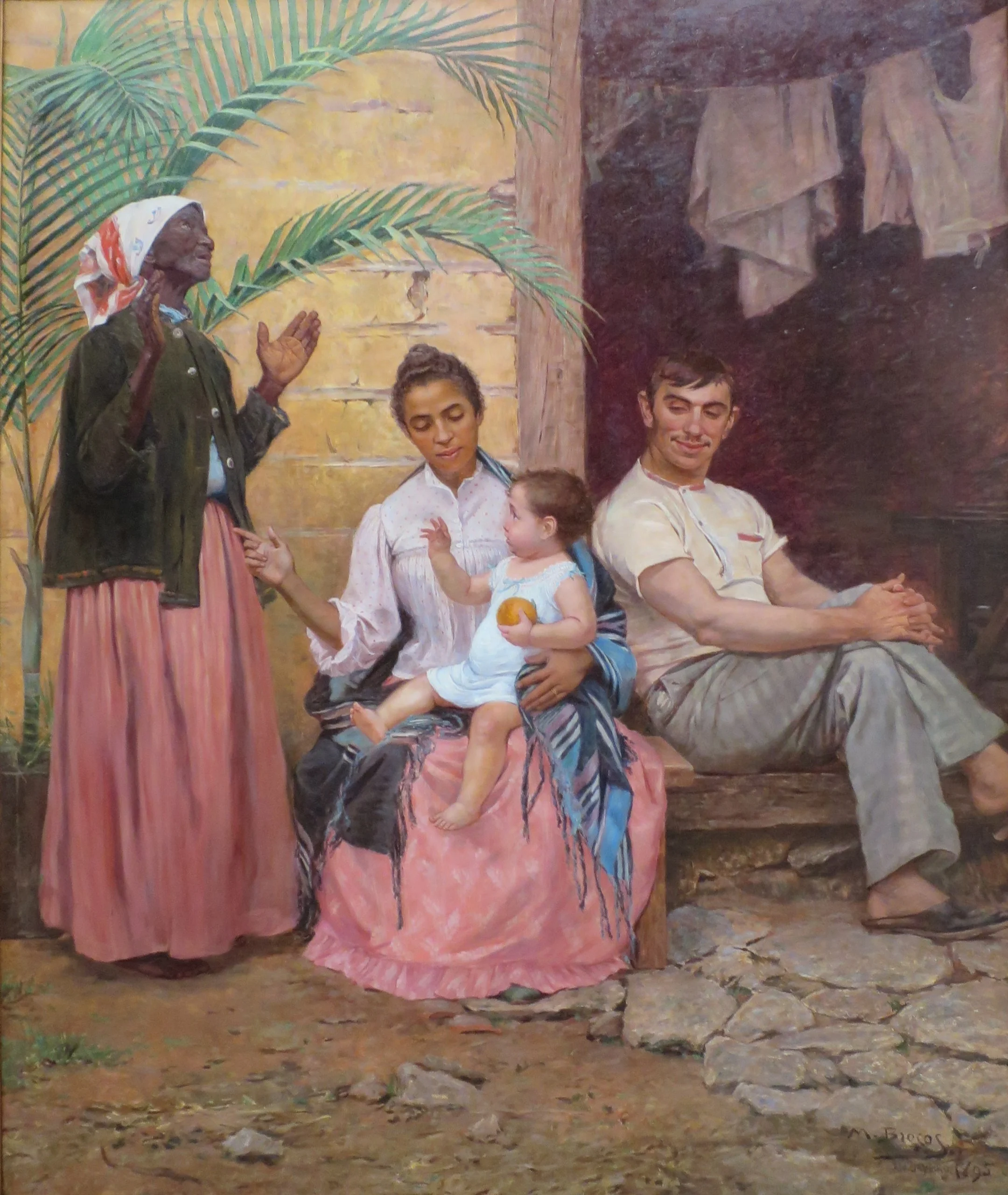
Brocos’s A Redenção de Cam (1895)
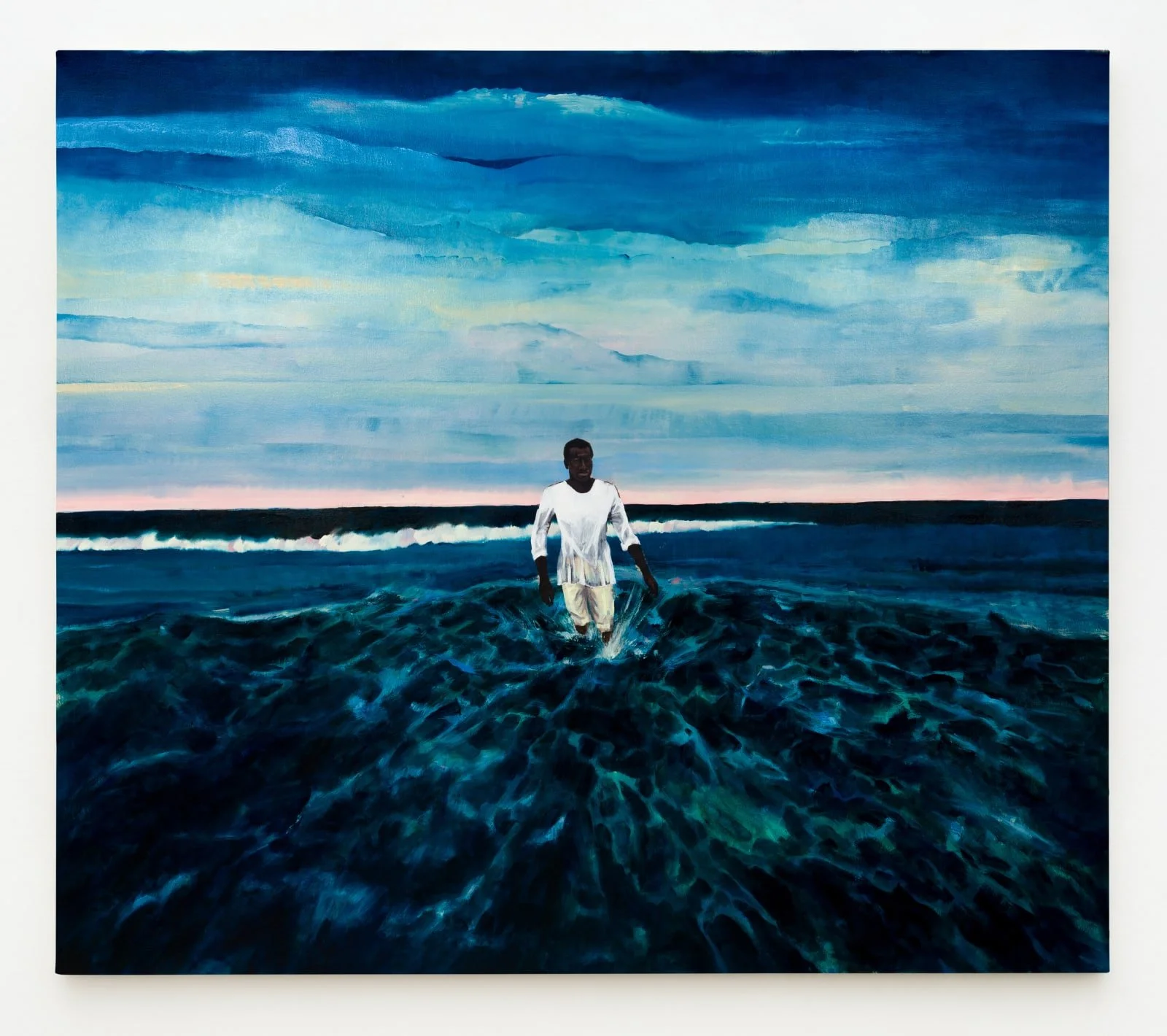
Obá’s Wade in the Water II (2020)
At the recent Social Repair team meeting at Walter Sisulu University (15–17 October), co-investigator Prof Paula Montero (USP/CEBRAP) offered a historically grounded analysis of how race, religion, and state formation intersect in Brazil. Her contribution illuminated how plural democracies manage difference and how these dynamics matter for Social Repair’s comparative agenda.
Plural Democracies and Their Tensions
Beginning with the question when and why racial and religious groups come to be seen as challenges to democratic politics, Montero argues that plural democracies operate with two distinct “grammars.” Racial minorities tend to mobilise claims around recognition, territory, collective rights, and historical justice. Religious minorities, by contrast, articulate demands around freedom of belief, state neutrality, and the moral foundations of public life.
Brazil exemplifies this divergence. Indigenous peoples have long been treated as ethnic groups making territorial claims, while Afro-Brazilian practices only gradually achieved recognition as “religion” after decades of repression. Pentecostalism, though always legally recognised, occupies an uneasy symbolic place in national imaginaries. These contrasting trajectories generate different expectations of state response and distinct forms of conflict.
Genealogy of Nationhood: Race, Religion, State Formation
To explain how these asymmetries emerged, Montero reconstructs how Brazil’s nation-state historically organized difference. Modern states use categories like race, ethnicity, and religion to determine membership and rights. In Brazil, these categories were shaped by colonial governance, slavery, mestiçagem (racial mixture), and Catholic dominance.
A central point is that Catholicism became the symbolic and moral backbone of Brazilian nationality. Its role in education, charity, and local governance allowed Catholic symbols to define national unity. Religious diversity was tolerated but rarely translated into political pluralism. Afro-Brazilian practices were criminalised or treated as superstition; Indigenous rituals were read through evolutionist frameworks; and Pentecostalism was seen as foreign or destabilizing.
Racial categories followed a different path. The ideology of mestiçagem celebrated mixture while obscuring deep racial inequalities. Black populations were incorporated through cultural and phenotypic vocabularies rather than through a language of rights, complicating later mobilizations against racism.
From Assimilation to Pluralism
The 1988 Constitution marked a major shift by recognising collective rights for Indigenous and Afro-descendant groups, including territorial protection, cultural rights, and the category povos e comunidades tradicionais. This introduced a post-national imaginary in which diversity is constitutive of the nation rather than an obstacle to it.
Religion, however, followed a different legal logic. The Constitution expanded religious freedom primarily as an individual right, not as collective protection. As a result, ethnic groups can mobilise collective claims, whereas religious groups must appeal to individual conscience. This asymmetry shapes contemporary conflicts: Afro-Brazilian religious communities often frame violence against them as racial discrimination in order to activate stronger legal protections.
Pluralism, Secularism, and Moral Authority
Growing religious pluralism destabilises older forms of Brazilian secularism, which relied on an implicit Catholic moral consensus. Secularisation in Brazil occurred through slow administrative disentanglement rather than a sharp break, allowing Catholic norms to remain embedded in public institutions.
Pentecostal expansion challenges this symbolic order. Pentecostal churches assert strong public visibility and moral authority, disputing Catholic dominance and, at times, the state’s moral legitimacy. Conflicts between Pentecostal groups and Afro-Brazilian religions — frequently framed through demonisation — reveal how religious disagreement intersects with racism. These dynamics helped justify the 1997 inclusion of “religion” under anti-racism legislation.
This shows a structural tension: the state must be neutral regarding religion but actively protective of racially defined groups. Afro-Brazilian religions thus navigate both religious freedom and racial justice frameworks, illustrating how these categories have become entangled.
Implications for Social Repair
Montero’s analysis speaks to the core concerns of Social Repair. Repairing social life requires more than re-establishing harmony; it demands institutional arrangements capable of mediating real difference and acknowledging that categories like race, religion, and ethnicity are historically contingent and politically charged.
Her reflections also resonated with the South African context of our meeting. Debates around pluralism, non-racialism, and moral authority remain central in South Africa, and across all our comparative sites — Brazil, Canada, the UK, and South Africa — similar dilemmas appear:
How can states navigate conflicting moral claims?
How do communities manage disagreement while preserving social fabric?
How can democracy remain inclusive when groups mobilise distinct histories and normative languages?
Brazil’s experience suggests that racial and religious differences produce distinct legal and political effects. Recognising these differences is crucial for any meaningful project of social repair — one that addresses historical injustices while confronting contemporary disputes over belonging, equality, and mutual respect.
Further readings
Montero, Paula, “Religion, ethnicity, and the secular world”. in: Vibrant – Virtual Brazilian Anthropology, v. 11, n. 2. July to December 2014.
Montero, Paula, Religião, pluralismo e esfera pública no Brasil. Novos Estudos CEBRAP, n. 74, 2006.