
Thinking Ubuntu
23 January 2026
By Kamva Poswa
Various terms resonate with ‘deep equality’, of which ubuntu is especially significant. At our recent workshop at Walter Sisulu University (WSU) in South Africa, our conversation focused on this lived African moral philosophy, which originated in sub-Saharan Africa. Co-investigator Prof Thabisani Ndlovu (WSU) in his talk took the team through the complexities of this philosophy.
Our discussion began with the idea that ubuntu is an ethos for humanness attained through social contracting that involves honouring communal relations and obligations. Ubuntu is about personhood perceived as a function of community and self-reflection. Hence, the expression umuntu ngumuntu ngabantu. This conveys the idea that humanness is dependent on how one relates to others. One may be human in the general sense, but if you are out of sync with the expectations of how humanness is demonstrated, you are said to lack ubuntu.
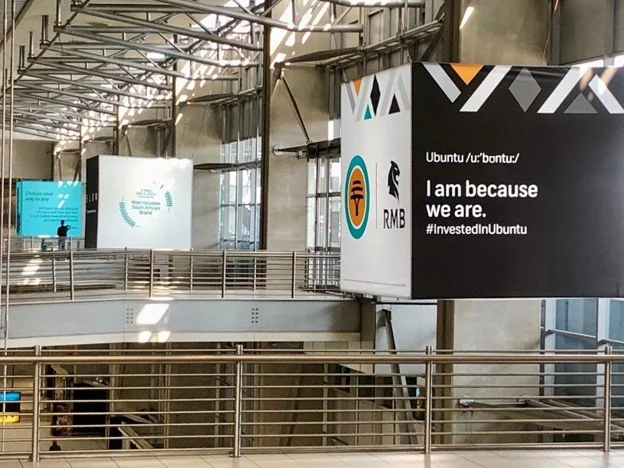
Ubuntu has also entered commercial language in South Africa, as seen from this advertisement at an airport (Photo credit: Christi van der Westhuizen)
Our conversation shifted to the pertinence of ubuntu in everyday interactions in social institutions, including the family. Within these contexts, ubuntu often manifests in daily acts of generosity, such as the sharing of resources, and through reciprocation of deeds. This is epitomised by an expression prominent among Nguni languages in South Africa, isisu somhambi singangenso yenyoni, which translates as ‘the traveller's belly is as big as a bird's kidney’. In this instance, households often offer guests the best they have, even when it exceeds what they may have for themselves. Though the intention may be confused as an attempt to impress guests, a deeper exploration shows this gesture conveys that visitors are worthy of respect. It creates room for reciprocation.
Our conversation extended to how the philosophy of ubuntu applies to other areas of human life, such as healthcare, artificial intelligence, governance, and political leadership, of which the latter often challenges the values of ubuntu. Notions of ubuntu may be manipulated for the exploitation of people and resources. One of the core values of ubuntu is communitarian existence, living a morally good life and having rich social relations. The current state of affairs in South Africa demonstrates a tension between ubuntu as an aspirational ideal and ubuntu as a lived reality.
As a key term in the Social Repair Project, ubuntu helps to interrogate governance and leadership. For instance, ubuntu-based governance would emphasise leadership through relational ethics, mutual accountability, and collective flourishing. Such ideas about governance remain aspirational, also elsewhere in the world, as humanity faces corruption, poor leadership and widespread incapacity to address socio-economic inequality.
Kamva Poswa is a Master’s student in English at Walter Sisulu University.